Philosophical Notebook XII:
the world is my vienna
6/27/97 – 4/19/00
Bianco Luno
“Love is murder.”
—Otto Weininger
“For the reason of your delicacy, you are doomed. If you cannot live within the rules of this house, plan your exit.”
The mouse to Diogenes.
What neither mouse nor the street oracle was able to predict was that “delicacy,” runaway consciousness, was itself the “plan,” that undue sensitivity would one day come due.
There is no hope either for the individual or for the lot of us.
No reason for sadness, however.
Sadness, as its opposite, requires no reasons.
But when available, it will train itself upon them as wisteria on a trellis.
The desire not to be victim of vagary is at the heart of the compunction to make things intelligible, to seek reasons.
Overpopulation is simply not a problem.
Genuine people are as scarce as ever.
Perhaps I am being overly pessimistic to go as far as to say they are becoming endangered.
What is clear is rampant growth aspiring to humanity.
It is hope that has become pestilential.
This philosopher seeming for a thousand reasons like everyone else walks the street.
For one very tiny reason, like the café paper napkins worried to a ragged pulp in the pocket of his jacket, appearances will fail him.
He fears he has misunderstood reality.
The future may not hold death for all, as he so certainly expects for himself and those few near him.
At the vanishing point, when he actually gets there, the path again may trail off indistinctly, expanding again to the best approximation of infinity presentable to the eye, naked or clothed.
The cliff he expects, a mirage.
There will just be more and more and as the burden on memory swells too great and he learns to forget to make room for more and more.
The species might endure forever by achieving a flatteringly high evolutionary stasis as we find nowhere else in the universe…or by knowingly turning into other forms with or without discontinuity, like tadpoles to frogs…
But what could motivate speculation on alternatives to death?
Why isn’t decomposition a good enough fate?
Why not nostalgia (hope operating in reverse) for the adventures of furrier ancestors?
If his vicarity cannot stretch that far back, if it stumbles for lack of familiar anchors, how can he fancy being vested in whatever comes long after?
The universe will go on in darkness and detail.
Through a surfeit of self-compassion he can imagine himself a light that flickered on and then off.
(In reaction to Rorty.1)
Isn’t the tendency of philosophy to raise certain common place notions as “goodness,” “truth,” “reality,” “beauty,” ... above the practical into objects of unnecessary conviction also evident outside philosophy: in religious disputes, or disputes about scientific theory, sports teams, love of country or ethnicity, or the eternal significance of one singular being?
The operatic permeates all enthusiasm.
The suggestion that there can be a cure, a supersession of delusion by fact, disturbance by calm, illness by health, that nothing is relative, that “relativity” itself isn’t the purest expression of uneasiness, of angst, that when we stop worrying we won’t stop period—isn’t this advice already rancid in its conception?
There is no hope, proverbially.
Add to this, there isn’t any hope that we will stop hoping.
There isn’t enough spillage in his life for him to rest content.
Obsessing on efficiency to the point of art is the last excuse for what he does.
It has become “you” because in using “he” or “she” in their gender specificity I would risk offending like a too ordinary lout.
“We” is far too presuming, “one” pretends I don’t know who I am talking about.
“You,” just right, forthrightly rude, a punch in the nose.
It is rude proper, Emily Post would have agreed, Gombrowiczian in intent, the requisite mens rea for conviction.
To live without illusion or at least without commiserating with the illusions in others.
A contradiction?
Or to generate a swarm of them about your self, a well-crafted muddle sufficient to distract all concerned from asking.
No time to think.
Fill up your days with nights.
No case, no verdict, no judgment, no possibility of ever knowing what hit us.
No, the muddle cannot be crafted and still maintain the integrity of a muddle.
Nothing you can imagine will serve.
You must wind down your stay, I have outlasted my welcome.
I was that up to the point of commenting on the furnishings.
I shouldn’t have noticed.
Either everything is sacred or nothing is.
Intermediate discriminations are incipient signs of oppression of one deserving party by another.
So we keep our mouths shut or we criticize all.
I respect everything but moderation.
It is the very model of profanity and will for that reason flourish without this affection.
A child should be spoken to as though it were a god, fully cognizant of the wiles and vagaries of adult excuses and justifications.
When it is told it cannot do something, it should be informed as to why anyone is ever allowed to do that thing, if anyone ever is.
If it is suggested that a child cannot have a requisite capacity for judgment on the matter, then we must be prepared to explain how it is ever determined that a non-child can have such a capacity.
And we can never say that this happens magically at a certain age.
We are addressing a small god to whom the lameness of our excuses looms very large.
If the child is curious, then it will have the wherewithal to understand, if you have the courage to explain.
And then it will be out of your hands what the child does.
If the child is incurious, there is no hope because there was no god in the first place.
Only another liar to add to our vast and proud collection.
Bury me with the others in the cemetery of vampires, implacable, periodically emergent beings condemned to eternity...
“Your blood in death will run warmer than mine.”
...it would be tantamount to saying the accretion of experiences transforms a child into an adult, which we know is not true.
It is magical how this transformation takes place, and for that reason inexcusable.
We inflict upon these children life and then attempt to shape its content for them, too.
Not happy enough with ours.
The lies these children will live by will have to be of their own creation.
Nevertheless, we do the right thing to torture them.
Aren’t we punishing them in advance for the crimes they will commit in our absence?
And in so doing prolong the generations of ever more refined pain and a sharpened consciousness of it?
What would have to be true for the view from here to be mistaken?
...as modern birds are from dinosaurs, this is how different from what we are now we will have to become, the evolutionary link virtual and a construct in time for the satisfaction of a distant curiosity and for a contemporary solace.
Picture dinosaurs on the verge of extinction waking to consciousness and stilling their runaway despair in a vision of their descendants gracing the skies of a future world without them.
The lengths to which Nature will go to remain naïve.
The poetry of the relations between great lumbering significances and their decorative kin is what we must come to appreciate if we are to fool ourselves in a grand way one last time.
That or believe the mission of our existence was fulfilled at birth.
Weininger was homosexual (rumor had it), Jewish and—to make the irony more delectable—should have been a woman.
When I finish with him I will have shown that indeed he was and had to have been.
“A rarified air you breathe, so starved of oxygen [hope], your lungs must be different from ours. The heights you climb, inconducive to health (as we understand it here on more temperate slopes) may be first lit by dawn and last to fade into darkness at dusk, but are no place for us to live.”
Profligate, exquisitely promiscuous, a wealthy dame who only cries today in order to laugh tomorrow... For her, the truth is like a chaste, soft, fragrant tissue; its task done, flush it...
The discarded one is a bitter, bitter, poor and hopelessly jealous mistress—yet, to one with eyes to see, as beautiful as shards of glass in the sun, constant and unforgiving, only ever the mother of miscarriages, if she could be the mother of anything...
Her eyes, at least, are very clear.
She is barren, now, having managed one child, a boy, named Death.
No, at these heights one does not live: the horizon takes your breath away.
A pain that burns and tears at the seat of my being drives me here.3
I want to see if I can see beyond it.
Will I one day be able to stand having my breath taken away forever?
Pain has built itself a nest in my body.
Mental pain, the pain of my own contrivance, born of educated sentiments, a proud civilized pain, has been unceremoniously eclipsed.
I now have something in common with the masses.
I can dance and writhe in sync with them.
Bowel movements have become the newest tool of my expression.
Thus, I do penance for the sustenance, the living things, sacrificed in my honor.
Space is replete with subjects of nothingness.
At the heart of some of these subjects is nothingness; in the center of others, pain.
The opposite of insanity is suicide.
“We have free will. You have a choice.”
One need only frame with quotation marks to frighten.
You begin to live fully when you have been almost dead, they say.
Near-birth experience must be analogous;...they were just beginning to settle into an eternity of non-existence when they were exploded onto the scene from between a woman’s legs.
Quotable philosophers and the philosophical crime of pandering.
Then there are Kierkegaard, Weininger,... completely unquotable.
Because both irony and sincerity do not photograph well or do not lend themselves as bulletins for superficially curious people.
Weininger explained his own neglect...
I can only explain his neglect in the latter half of the 20th century as a kindness—not to women—but to men.
It is Weininger who first made the plight of women clear to me.
Accounts prior and since by men are muddied and unconvincing, their second-hand nature in evidence.
And those by women in a strange language, made especially treacherous by the use of the same words to mean different things.
But Weininger was the Rosetta Stone: no man has ever been clearer about what is fundamentally a male confusion about women.
It is and should be men who fear his book; more than women they have suppressed his work—motherworshippers all.
Be boy, or die!
(failing that, I would rather be a woman, a girl, a dog—anything but a man!)
My biscuit, my dear indecorous portion, meager but true to its fullness—it will take time, an infinite quantity, to wash away the snowy yellow dust, the condensed, desiccated exhalations of generations of humanity.
At the distant hour of its revelation to wondering, insinuating eyes, like cave painting, too open to interpretation to communicate the fullness of the author’s urgency—until then, the biscuit will languish in the grey-brown slime on the plate.
Obviously, Weininger was wrong—utterly and completely wrong! The astonishing thing is how the gender of character so contorts itself to match to a tee his description.4
Men kill themselves for one of two reasons.
(They are not the same.)
Because they cannot live with themselves or because they can live with no one else.
Weininger was an exemplar of the latter and much scarcer sort.
The use of “man” in an earlier usage to describe a general humanity and not specifically men ... but this was not so clear ... the ambiguity of the term “man” was known even then. And it was exploited. Sometimes, perhaps, when they were feeling magnanimous, bloated with liberality and expansiveness, they (men) truly meant the larger extension.
But more often the polite fiction was indulged in deference to mixed company. They would all along really mean men when they uttered “man”—men and the women who thought like men enough to pass. The others were, for present purposes, whatever these were, not accidentally excluded from reference.
The paternalist generosity of the first attitude rightly offended the feminists who expected, or at least demanded, that men think straight and not like inauthentic and ever distractible women.
In the second case, while perhaps they were guilty of polity, there was at least no play in intent.
Thus, there are at least four identifiable mental genders: male, female and their discontented (manqué) counterparts. They can coexist in any combination in the same person and often do. Local, historical and cultural, conditions favor now the ascendancy of one, now of the other. It was Weininger’s mistake to think the more distilled pair worthier of encouragement. The clash of interests better illustrated in these, the possibilities for moral development in the direction Weininger foresaw appeared more abundant.
Isolated moral consciousness, infected with the idea of perfectibility and its attendant imperatives, stood a better chance of weeding itself out of existence. Convincing one half of the population that it has a higher purpose than reproducing itself would be sufficient. Putting aside the obstacles to converting even that small proportion (which his idealism could have accommodated), there remains the question: Is this the only hope for achieving his intended result?
It should be clear that I think his intended result, the minification of the species, is inexorable and will be brought about by any and all mechanisms, natural and unnatural, we can imagine.5
But should it? That question persists in the face of whatever happens; and the fact that it does illustrates how independent of the facts the realm of value is.
Of more interest and the object of debate are the aesthetics of our undoing. Weininger pictured one very beautiful image. Bishop Berkeley another very tidy. de Sade and Kierkegaard proffered messier ones, but which if only because they were less blinkered by idealism or any of its equally metaphysically-ladened competitors, have a truthier odor about them.
Weininger’s most endearing virtue is that he can be interpreted as exhorting men to be men and to embrace the death of the body as if it were their special vocation—or failing that, confess themselves cripples and beg the world’s indulgence while running to the safety of her skirts. As such, he is the secret friend of the most radical type of feminist and the mortal enemy of all men suckled at the breast of hypocrisy or culpable innocence.
But what shall we do with the run-of-the-mill feminist? Those unthinking enough not to see completely through their male counterparts, themselves too vulnerable to a concocted “mystery of woman,” believing it to be distinguishable from the mystery of being alive and the wish to have it stay that way.
What shall we do with them?
What will they do with us?
Anything we could object to?
The latter and much rarer sort that “can live with no one else” because they have become possessed by a truth exclusive of the ends of living, breathing, quivering things...
It is not properly spoken of as suicide, rather, as murder.
Visions kill.
And here is explained why we sooner forgive the common murderer than the suicide.
Chronic victim-blamers, but we assign certain victims more blame than others.
The worst sort are those that dare say something true in the act and nothing having to do with the enterprise of created things.
The deserving victim’s crime is one of poor taste: his choice of murderers leaves something to be desired.
He made the error of informing humanity (or at least the male half) it had no business here.
Almost immediately, he saw the intolerable contradiction, if not the slightly more forgiving futility.
There in the house where Beethoven died.6
Aristotle’s akrasia is the normal state of the will; by turns appropriately precious and pathological, its complement.
But how can a very high-flying music for chorus of Lesbians and engineered, fixed counter-tenors ever stoop to attain the dies irae called for in the text?
This is the challenge Weininger presents us with.
The pain in store for us is going to have to be exaggerated in anticipation ... so that we will over-prepare, meet what’s coming with relief, and maybe perish thinking the universe not so unkind as all that.
My carnival mirror distorts philosophy to its highest advantage (contrary to what I teach my students).
Utilizing an array of basic fallacies, I can attribute entire worlds to my dead victim-thinkers, my straw figures offered as markers in homage to the rich fields overgrowing their effaced or plowed up gravestones.
They serve as scarecrows for warding off vermin.
I bear false witness to these false judges.
Now Berkeley, what could he have meant by so tidy and malicious an epistemology?
A universe “freed of existences”?7
What moral claim do you suppose he was alluding to?
It is not my contention that the naked thought ever crossed his mind.
It had no need to.
Aspiring as it does at times, when not smearing itself across the empire, to a judgment on the lie of the garden, a slug will rear up on its hind-half and gracefully wave its stalks to savor the particles in the air.
My heart goes out to these soft beings.
Only barely guilty of the crime of movement.
It pains me to see them spread like jam on the walk every damp morning and evening by the absent dumbness of armored feet.
These consummately empirical creatures, dutifully (if so embarrassing a word can be said of them) re-incorporating matter as it decays; I find their lot poignant.
O describes one on whose back she inadvertently stepped.
It raised its head one last time to the sky!—before silently, prayerfully, bowing back to its god, earth.
No doubt they would trace their shining paths over my decomposing body lying undiscovered in a wood.
And so maybe I am not fully authorized to pity them.
The reverse, as likely.
They never toy with the worst of terrestrial sins.
Shunning light, no object of curiosity for them, they would never openly, willingly—never with enthusiasm—risk their earthly existence, courting the favors of something as plainly foreign to present purposes as a flame or a light bulb.
As do the pilgrims of light whose crunchy, singed husks, entangled in discarded spider netting, whose scarce body fluids digested and excreted to form little salt and pepper spots beneath the cruel focus of their adoration...
Where were my sympathies? (When I had them.)
Never content with what is possible.
Because what is possible is nothing.
The impossible, at least, has never lied.
The female lovers of Jesus, supreme in their conviction, Cioran wrote of,8 are perfect mirrors of the ideal Weininger glimpsed.
No earthly male could make them swoon as much as he who was the son of God.
In such a way, she sets the stake.
The earth can move quietly about its business beneath our feet.
But it is not our destiny.
Sustaining our conceit will lift us from the empire into the empyrean.
It is fitting that we are mortal and cannot be tortured like this forever.
Weininger was correct to situate consciousness in the masculine, but the scourge of consciousness, necessary to counteract the sloth of flesh, is not to be found but in the feminine.
His consciousness withers to nothing without her as object.
His stupidity stoops lower than any within her range.9
(Here we go...)
Logic and History: An exercise
To illustrate to my student the application of one discipline to another, I offered this for consideration:
The American decision in World War II to drop the bomb on Japanese cities is usually justified by appeal to the desire “to end the war more quickly”. All parties concerned up to the moment of the decision knew who was winning. The point was to curtail the human costs of the war. A war may be proactively “ended” in only one of two ways: by winning the war and by surrendering. The second option was, in this case, absurd. Ergo, to end the war more quickly we must win the war more quickly.
Now, let’s consider Nazi Germany’s decision to exterminate 11 million Jews, Gypsies, homosexuals, Communists, mental defectives, their sympathizers, and assorted other undesirables.
It is indeed a “final solution” to unending strife to simply eliminate from the scene perceived partners in strife through a grand gesture calculated not only to rid us of a problem but to make an impression. The impression is necessary because a quiet riddance would not have the adequate deterrent effect to enable “plans for peace”. The resulting world—comprised now of either one persuasion, or, if shared, shared with self-acknowledged subservients—would be challenged to find new cause for conflict. Being the party eliminated from the conflict, again, is not an entertainable proposition ...
A clean apposite application of disjunctive syllogism washes us ashore of the lake of deliberation.
Recent history (following in the steps of ancient) provides no end of opportunity to practice our venerable principle. Native Americans and Manifest Destiny; the Armenian, the Nanking massacres; cheap energy and East Timor, and Iraq, and ... etc., the inertia of economic stratification in Chiapas, in Tibet, in Bosnia, in Rwanda, etc., in every case, the “us or them, not us, therefore them” rule has made our day. My patience with the realm of the historical concrete, as a former student of history, is not what it used to be.10 A somewhat belated recognition of this has driven me finally into retirement among my toy abstractions. Always craving organizational simplicity, I knew I would never be suited to understanding by any other means. Smug in my choice to be free of the tyranny of details, I discovered logic.
I recommend it. It calms the nerves. When it comes, death will—in the light of logic—have the air of déjà vu.
Order thus descends as if from on high upon my topic.
The conceit that my mind is large and complex enough to process and properly dispose of such mass quantities of exculpating minutia melts away without a trace of sheepishness.
My new tool has proven so handy I can make quick work of human treachery.
“It all makes perfect sense now.”
I may not like myself or the world I inhabit, but I cannot—in all candor—suggest that I don’t understand it.
My student suggests that perhaps I may oversimplify ... but what does she know?
More than can comfortably fit in my head, I’ll wager.
But for such comfort, there must be great spaciousness, more than my allotment.
Facts so obvious sometimes we fail to notice:
- There is no God, but there is most certainly a hell.
- We will die later today, tomorrow, or the next day, etc.
- Sometimes, it seems, I am not in pain.
Weininger: how is it that women have no souls, minds, or morals?
How is it we can contemplate blossoms without humus, a table set with delicacies without a pile of steaming feces, smile at a cavorting boy with no thought for the criminal in larval stage, the data of life without the fact of death?
How is it one thing can suppress by its charm where it came from and what will come of it?
Never mind that we manage it each day...
Wouldn’t I as invalid rather be tended by a nurse concerned with stitching the paisley fabric of humanity than dutifully by an attendant on the basis of some skyscraping principle?
Would I rather be loved as a mathematician might a certain non-repeating decimal or as sculptor caressing her stone?
A lot of good it does my poor body to have its soul elevated forever and ever above the atmosphere.
I would have to have not had somehow been quite early on deformed in my instincts, had my self-concept traumatized by abstractions and my sensibility turned on a lathe operated by a hater of nature to not see the possession of a moral, mental and spiritual existence as a positive defect of being. The only morality worthy of praise is that which prizes intimacy of purpose above correctness, the only mentality—that which produces the comfort required for the exercise of that intimacy, and the only spiritual—that which assuages fear, the cancer on everything that is truly good, right? Other conceptions of these terms lead us more quickly to death, or worse, the death of whole collections of us.
Now, is it really so bad not to partake in psychic constructs or to be unmoved by celestial etiquettes?
...I am never comforted by your agreement with my rhetoric. I sounds like a rock hard biscuit fallen down a hollow pipe. There is something suspicious about it... I have more biscuits. We’ll return to this subject again and again.
“The presumption is that the referents of these terms are good things to have around ...” It should not be a presumption.11 Weininger assigned the referring concepts to a special idealized domain. In that domain the attributes are not so much “good” as calls to otherworldly responsibility. To the extent they impact ordinary life, they are curses, scarcely objects of desire. And to the extent “ordinary life” is the only life there is, how bad can it be to be so unencumbered?
It is not entirely with displeasure that a woman may play host in her womb to a future murderer.
The submerged maleness in her breaks the surface in resentment at the thought of her body being used in this way by Nature.
It may be she cannot raise her fist high enough but she is not without resources.
The boy as instrument of vengeance.
A tiny wren picks at crumbs, swept from the table tops to the café floor, the doors wide open to the cool summer morning.
This bird is out of proportion to its importance.
Another dead squirrel in the street ...
Forgive me for not understanding why it is we “deserve” to live, why it is I feel less compassion for the victims of a terrorist bombing.
In my quiet part of the world where the only dead things I see day-to-day are these creatures ...
For billions of years Nature was unimaginably brutal without anyone having to see it.
Not content with her unappreciated carnage, she evolved witnesses and accomplices.
The crime scene is fully casted.
There will be a judgment.
It will mean nothing scrutable in the end.
But just the same...
Women and men arrive at and depart from wisdom in different ways.
Male wisdom, at its height, is negative, quintessentially Socratic: it consists in achieving the conviction that one does not know.
For a woman the corresponding conviction is that one does not need to know.
This is not negative because it frees energy in the direction of action in contrast to the male state of aporia.
(The negativity I speak of is relative to this world, not some other less bounded one.)
Men are busy up until (if ever) they reach this state.
Wisdom, for a woman, is the beginning of enterprise.
The way a homeless person surveys the city in search of a suitable station for the night, a place with some protection from drizzle or frost, among entryways, park benches, overpasses, the shadows of public art—a bivouac only miserable enough to make the enforced accommodations subsequent to arrest seem luxurious and less to be feared ... a similar vigilance for resting places free from harassment for a short space of time among the ideas furnishing the mindscape at the turn of the millennium afflicts me.
No conclusion but for the night.
Fitful rest.
The arms of faith will wait forever.
In a cashier’s face I saw God briefly.
Her eyes counted change.
All of this suddenly explained and I understood.
The movements of galaxies and her fingers over keys.
I put my change away.
There used to be a God a long time ago.
And maybe again a long time from now.
Now—where I am always at—here there is only bewilderment and stupidity surrounded by treachery.
I don’t know that I am complaining.
My harsh judgments may convey the impression that I know what would please me.
I don’t know, and it would not matter to me—if the change was correct.
The explanation she embodied for an instant was adequate.
Adequacy—is this what you want? If everything for everyone was adequate? ...
Then what?
Excess in any direction fills you with shame.
But the middle ... Aristotle’s muddle?!
It is the self-congratulatory conceit of men “sensitive” to the plight of women that never fails to be offended at Weininger’s claim that women do not pass muster.
What dehumanizes most?
To be told you lack certain essential features of the human—or to have these features defined by others who are blind to what it is you are?
If we should treat each other as “equals,” it is not because it is in your or my interest to be so treated, but because we have both agreed to be tormented by the same idea, i.e., to re-grade the playing field so that it does serve our interests.
In this contest, we exercise our native or acquired skills.
There is going to be a winner.
So much for the idea.
Long ago I also spilled apples from a barrel.
Perhaps because I have acted too slowly—unlike Descartes—I have not found any meriting being put back in.
They all seem spoiled.
Or I may not be properly motivated.
Neither God nor anyone else has been there to guide my hand in the selection.
Advice from every quarter has seemed as spoiled as the apples, which, if they were not that in the beginning, certainly are now.
An act of charity is as selfish an act as any other.
Whether it was an act of kindness or malice we were given birth, we start out owing.
Not to our parents ...
To pinpoint our creditor or the amount of our debt is to compound it.
In virtue of being born we owe everything to everything.
Nothing, not even death, will forgive our debt.
The magnitude of the initial gratuity casts its shadow onto all subsequent eleemosynary conceits.
We are immortal, or insist on it, because that’s how long we will go on owing.
All humanity knows—if not the truth of it.
Men, especially—and with every bit of native strength flee it.
The human mind cannot remember that the world is flat (to paraphrase Miss Stein).13
Hampered by the knowledge that it is otherwise, blinkered by the view from on high, it brings tears to my eyes.
Moore felt obliged to remind us we possessed two hands.14
But, as certainly, hands that lose their grip.
Science was my first love.
My fourth grade teacher called me her “little scientist” because I had read every science book in the elementary school library and knew the names of all the moons of all the planets and what their atmospheres were supposed to have consisted of...
I knew so much then.
Things I no longer know how to do:
- Vote
- Answer someone who asks how I am
- Understand someone who tells me how they are
- Believe
- Accept responsibility for anything less than everything
- Say sincerely, “I don’t know...”
- etc.
It is not likely that I ever knew enough.
To say that it is the desire that has been lost does not help explain.
I learn from Miss Stein that contradiction describes a state of affairs in the geography of human nature, if not in the human mind, of which we can know nothing except what it constrains language to say.
As a boy he must have been informed that it would come clear as he grew older.
He called their bluff.
The most insidious form anti-Semitism, racism, sexism, homophobia, xenophobia, etc. takes is the appropriation by forces both in and outside these groups of self-criticism as evidence of inferiority.
We play into their hands not to see our own flaws.
At least as much—and I would argue more than—as if we responded in kind or pathologized them in return for their efforts.
Unable to live with what I know.
No more the excuse that, like you, I must set aside these things as “eternal mysteries”.
The empathy afflicting consciousness at the sight of a suffering animal—even one being killed by another for food—is at the heart of our conception of morality.
The capacity will expand in ever grander enveloping circles until it calls for our ultimate sacrifice, self-destruction.
Indeed it should and we will come to see that it should.
(The “should” here comes from the refinement of consciousness itself.)
If we don’t through carelessness first.
“The only thing about human nature that holds the attention is that it has a beginning and a middle and an end...” —Stein16
There, in the house where Beethoven died, his finger on the trigger of the gun at his head, little Otto may have answered Miss Stein’s question on the utility of having been born boy.17
My hatred for Aristotle is so intense I almost love him.
I must rein it in for, by his own admission, he was worthy of neither.
Kierkegaard took ill and died before he could become an atheist.
Nietzsche, mad before he could become a Christian.
Weininger, boy-philosopher, killed himself before he could become—a man.
I continue to tread water.
On one or two occasions I have almost drowned.
There is still no land in sight.
So many ways the world could have been.
Yet it is this way.
I fall on my knees, the dignity of reality stripped away at the thought...
but to what, to whom?
Medea and Weininger.
Asking mothers to murder their sons is like asking men to refuse sex.
This signals the magnitude of the problem.
When consensus starts, thinking stops.
And “agreeing to disagree” is an agreement to what?
... fatigue besets both sides; conviction, let alone truth, nowhere in sight.
That in which each sex finds its salvation also fixes respective value.
For one, the creation and maintenance of connection, for the other the refinement of consciousness.
A purely matriarchal ethic would only sanction behavior conducive to the former.
Not some barely discernible abstract principle, law, or right, but a simple duty to foster ties and to live through them.
This connection to eternity would be sufficient and too much clarity with respect to it vaguely obscene.
Prayer to Woman
O Woman,
O Mother of gods,
have the courage of Medea.
Slay your sons before they can spread their sickness to the bitter ends of the earth;
and lest you, too, become implicated in the destruction they will engender...
I have a secret to tell you.
Perhaps you have not heard.
(Or if you have, I am at a loss to understand!)
Has any man ever told you that what he really wanted, even more than your sex, was to die?
What other message to humanity could possibly be conveyed by his interminable crimes of violence, of war, of appropriation, of destruction ... except that he craved so badly to be relieved of the burden and misery you so innocently(!) bestow upon him—his life?
How could you be so dense and unthinking as to have not been moved by the eloquence of so much aired blood, much of it even your own?
What can you imagine is the meaning of rape, if not to incite you to your duty?
What instinct has made you so weak that you fail at what would be so easy to effect with the special privilege you have over the boy?
For he cries out to be lovingly killed by his mother, who alone can murder him with impunity before the judgment of the earth.
For his crimes of war, of rape—as good as done at conception—you are fifty percent responsible.
He does his part to free humanity of itself, what do you do?
The mathematics of responsibility is irrefutable: the percentage is exactly 50.0000... to as many decimal places as you care to take the calculation.
It is not 49 or 51 but coldly, cruelly 50, no less and no more.
The act of impregnation, we grant, is his fault, but the live birth yours.
And in righting this evil, you have not participated in proportion to your due.
Has not your significance in the universe been displaced adequately? Your soul demeaned sufficiently? Your materiality ravaged enough?
Search the eyes of your rapist-lover during his performance, what do you see there?
What shall it take?
More are being born than are being killed.
It is too great a task for man alone to complete.
Everyday, every moment, more and more blood goes unspilled.
What for,
O Mother of gods,
are you waiting?
Show us the mercy so often claimed for your sex.
“Love is murder.”
If you kill your sons, you shall not have to kill your daughters.
As Adam was at first, Eve shall be at last.
What impulse hallows the child more than the old woman or man, making the death of the former a greater tragedy?
A crazed serial killer making victims of people standing in line (for groceries, tickets, restrooms...)
Is the enormity of victimhood greater at the start or near the end of the wait, or yet after we get what we came for?
Genius and idiot.
Morality does not apply to them.
Nevertheless, they suffer its consequences as long as they live among huge populations of those who are neither.
They will never be afforded a morally correct place to rest.
Deviance is tragic because it ensures that neither guilt, nor atonement are possibilities.
Even animals are sometimes subject to this tragedy—as when a perfectly healthy animal is executed who happens to “mistake” a child for prey.
The animal did not even dare, it just did.
Nietzsche’s superman is treated like a rabid dog.19
This is my diary.
It talks about you.
You have made the mistake of reading it—breaking its seal and peeking...
My stupidity and carelessness extend only so far to explain our predicament.
...thus, misogynists come in two stripes: those who hate women and those who love them.20
Both have their fans among women themselves for whom the regard is often more precious than its character, especially when the consequences are the same.
When the vast majority of men are completely indifferent to them as women.
They do not perceive women as either threat or salvation (as opposed to objects of comfort or pleasure).
To not see your enemy as even that is the lowest cut.
There probably really was something wrong with Weininger as the diagnostically minded are inclined to say.
Certainly he violated a point of etiquette among suicides by shooting himself through the heart instead of the head.21
Sex differences.
Men are all that women are and something more.
Or something less.
It was Weininger’s genius to give us the chance to have it either way, an arms dealer in “the war of the sexes”.
Whether “more” or “less” has more to do with the surety of your being, the level of comfort you feel with your limitations, with the face you make at death, than with the form of your genitalia.
Would it really be nice if we could avoid “more” or “less”?
Settle for stalemate?
I understand perfectly well the cause for complaint.
But what can we be thinking when we envision an alternative?
Why is “equality” so valuable when nearly all eternity shall be spent in that state?
The word is misused outside mathematics.
“I want what you have” better expresses the political imbalance.
But this calls for investigation into what it is you have and how it is the same and how it is different and how one is to know.
“Sexuality was to the Greeks, but also to the Old Testament Hebrews something natural and naturally accepted.” —Hans Kohn 22
Sex may be sufficiently natural but being human is not…
Or Nature is large and magnanimous enough to care and fend less for itself than we give it credit for.
I don’t know if I am capable of loving and it is not likely I will ever know.
If anything I do should be so described, the suspicion and its foundation will have to come from outside of me.
Here, in the small room where I am rumored, it will remain a mystery.
I do not live as I do from any sense of duty or from any instinct.
That, too, would require knowledge of something I do not have.23
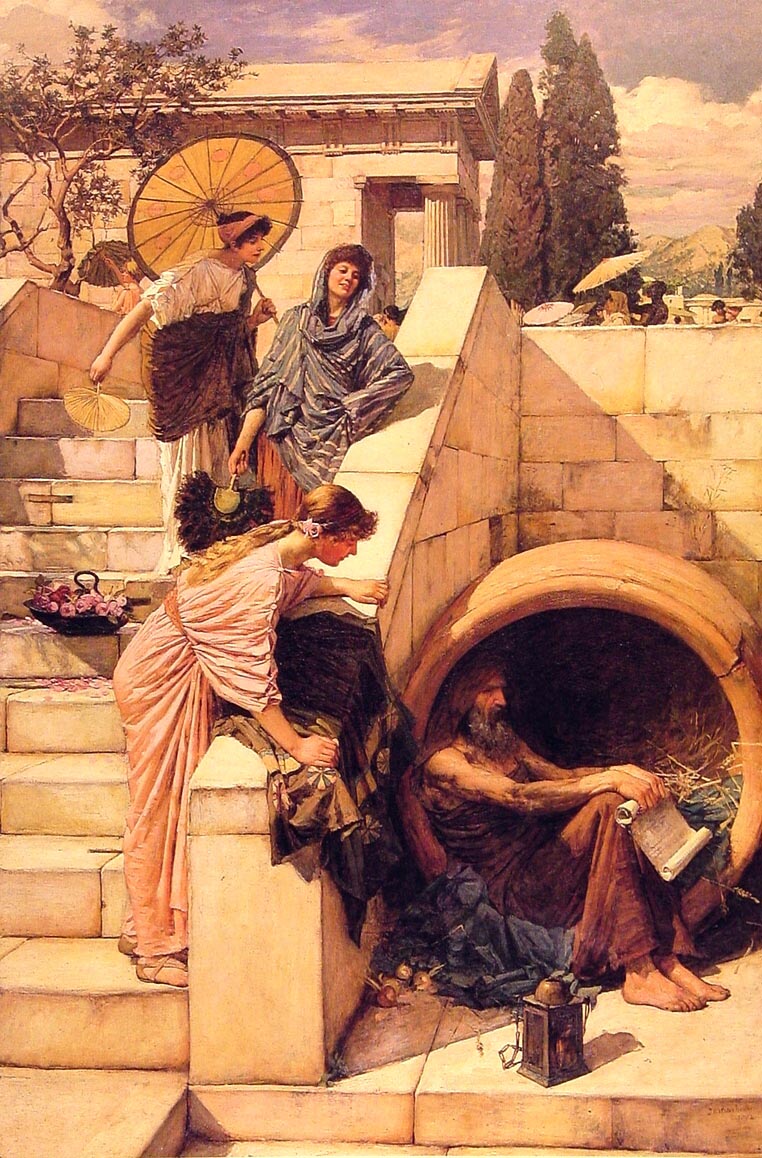
If Diogenes could not rule the world, he would live on the streets like a dog.
Or a criminal, or Weininger.
The will to power having been divorced from its object and become the will to value.
The rat becomes teacher.
Judgment on the self having superseded all other kind.
Abortion as metaphor.
It is the heart of feminism: she seeks to destroy his creation inside her.
A woman is an offense to a man in the Kierkegardian way Christianity is an offense to the human.
I will not say it is impossible to overcome the offense, but no man is credible who claims to have done so.
At its most perspicuous the radical feminist recognizes this and proceeds as from a premise.
Gender specific values are in permanent struggle. The “war of the sexes” is really the only war there is. The rest of culture and history is concerned with expressing it through violence and sublimation. Or contriving, at great cost, some truce or “understanding” but always on a precarious foundation consisting of the momentary exhaustion of one or the other party. For these impulses and imperatives cannot mix without loss of integrity. The viral condition of inauthenticity is only cyclically in remission.
Study the weak so that you can treat them as harshly as your relative strength will allow.
In the fullness of time they will return the favor.
I’m not talking ethics here but history.
History assures us that no one will in the end be accused of being irrational. (“In the end” is what history is all about.)
Abortion and mother-induced infanticide ought to be the first forms of murder we legalize when we get around to it.
At an earlier stage of our evolution when we had yet much to do this might have been an abominable thing, but children simply are not what they used to be in terms of value.
Next, as we proceed to civilize and refine war, we will set aside whole continents for the exclusive use of men for that purpose.
But women and children—those surviving through a surfeit of love—will be evacuated from this theatre.
Men, when they come of age, will be encourage to go there and fight it out to their heart’s content.
It will need to be viewed a true blood sport.
In all other places war will be illegal.
The only human beings allowed to live will be those who are wanted and want to.
Death will be a mercy to the others.
“It is indisputable that the being whose capacities for enjoyment are low has the greatest chance of having them fully satisfied; and a highly endowed being will always feel that any happiness he can look for, as the world is constituted, is imperfect.” —Mill, Utilitarianism, Chapter II.
The more endowed, the more imperfect.
We’ll have to excuse the gifted their smugness; it’s the only consolation they will ever have.
To care about others is to have enlarged the self, not to have left it behind.
It is to have treated one’s disease by sharing it.
The claim that human society is morally stratified into those capable of understanding (though seldom doing so) and those who will never be so fortunate (the vastly better portion) is only a quasi-empirical proposition.
For the studies that might show this must assume it.
The philosopher’s worst fear: an objection lurking around the corner, completely unanticipated and devastating to his vertiginous edifice. The higher the edifice, the more frightening the possibility, the more tempting self-deception… An ordinary fall from a seemly height, a stumble he needn’t have worked so hard to avoid.
The climber of peaks could have stayed on the foothills with those out for no more than diversion. With them he could have lain on his back on the heather surrounded by alpine flowers just beneath the snow line and looked up and safely appreciated the awe-inducing sight of principle. Instead he risks falling gracelessly into this splayed position from on high.
He has a special obligation, however, to give a truthful account to those who do not attempt the climb. Their allotment of lies they are content to spend so freely. Thus, he consoles himself.
All the same, the view from up there, they will never know. And all around no one feels too sorry for anyone else.
Clarice Lispector depicts the danger and ecstasy of a fully composed and comprehended feminine now, opposite Weininger’s eternity.
The ooze from the crushed cockroach vengefully resists abstraction.
“The future will be precisely a now again.” 25
The compassion we feel for Weininger’s mirages stems from this.
This now is indeed all there is, ever has been, or ever will be.
The thought is too short and inconsequential for passion to get a purchase.
The moment has no room for belief.
Weininger actually believed in something.
Almost exceeding his entitlement.
“The self-appointed removers of false beliefs from those for whom these beliefs may be all that sustains them can be as harmful as the most callous liars.” —Sisela Bok 26
More harmful, perhaps?
Because if she or he succeeds, the believer of lies will cease to have a world to inhabit.
Apart from its rarity, can we imagine such truth telling desirable?
… maybe “truth” is the wrong word for what we want.
But since there may not be a word for that, “truth,” a term answering to nothing, best describes it.
“Can one be guilty of being innocent?”
—Jean-Luc Godard, France/Tour/Detour/Deux/Enfants (documentary film, 1978)
What can we do to make seem sensible what is true?
Its whisper in the clash and din of exigency, the roar of breathing, will keep it unheard in all but some cranny where the furious currents eddy and cancel each other out.
It lives in little whirlpools of stasis and inconsequentiality.
Like the view from high on gutters and ledges that nesting city birds enjoy.
A view one would have to have something amiss with oneself to take.
Have the eyes of birds who do not play a part in our stir.27
Whose eyes see barely more of our truth than stones would if stones had eyes.
But if stones had eyes they would see it.
All of it would be completely visible to stones.
We must educate these stones before they do us…
“A stone, e.g., by nature moves downward, and habituation could not make it move upwards, not even if you throw it up ten thousand times to habituate it…” 28
…despite Aristotle.
There is a supreme violence in my philosophy.
For which I don’t expect forgiveness and would distrust it if it were offered.
The sex of philosophy.
Weininger’s insight that all philosophical controversy is founded on sex difference was put to some use by Freud who of course psychopathologized it to suit an age enamored with the related disciplines of science and pornography. Good that Weininger didn’t live to see what a mess was made of it by an army of Freuds.
Idealism.
What is will be different tomorrow.
What should be is forever. It is fundamentally averse to reality. Its neverchangingness a delightful burden and a tormenting object of passion. To be informed that “reality” dictates otherwise is to be informed by a hostage that the bother is over because her takers have died.
Which is worse?
Eating or being a cockroach?
Lispector or Kafka?
(Hint: it has to do with women and men.)
In women who have actually read Weininger, do I detect a peculiar mix of pride and sadness?
Motherly pride that a son of woman could reach such heights of purity (rare among men she knows); sadness at the fate of his person and thought: his suicide and the misunderstanding of his work, respectively.
Lesson in irony
A tractable sense of the word, the logician’s, suggests that an ironic assertion is not meant literally. There is another richer sense in which it is and isn’t. Kierkegaard’s sense, I would call it, and it is perilous bait for fools who cannot imagine paradox resistant to resolution.
How can we tell which sense confronts us? You must gauge the intelligence of the speaker and perhaps strain your own. Intellectual courtesy demands you grant the speaker a discernment at least equal to your own. You have to ask what phenomenon might call for semantic outrage in its description.
If your charity is misplaced in attributing more sophistication than is warranted you may still learn something. You may arrive some place even the utterer of outrage had not meant you to go and that you would never have visited on your own.
For example, Wittgenstein is reported to have said to Elizabeth Anscombe (his translator and esteemed colleague) in a classroom that, now that the women had left the room, they, Anscombe and himself, could really do philosophy.29
Reply to Godard: yes, innocence is a crime for which children are punished, and, we gather from the punishment, it is the most heinous of crimes.
They are condemned to a lifetime of adulthood capped with a sentence of death.
Death row for life.
If freedom is good then the possibility (and actuality—in the fullness of time) of evil is good, too, because it is required; it is the natural fallout of freedom.
This thought undergirds scientism and Marxism. That evil should be a requirement is offensive to our aspirations.
If freedom is evil…, there is no good. There is simply the world becoming conscious of itself momentarily.
Momentarily.
The patience of thinkers who expect to live a long time.
These philosophers who splash about at the shallow end of the pool. Who never learn to swim.
1. Probably a reference to Richard Rorty’s Philosophy and the Mirror of Nature, (Princeton University Press, 1979) which we know Luno was reading at the time.
2. Although Luno’s inspiration can be traced at least to Diogenes and Jeremiah if not still earlier to the Epic of Gilgamesh, through the classic French moralists, La Rochefoucauld, Chamfort, and Montaigne, the odd German or American, notably Lichtenberg and Bierce, in modern times his efforts at disabuse find special affinity with the fin de siécle Viennese moralists: Kraus, Wittgenstein, Otto Weininger, Adolf Loos, Arnold Schoenberg, Oskar Koskoschka inter alia as well as with more recent related temperaments such as Thomas Bernhard, Ingeborg Bachmann, and Elfriede Jelinek. These cultural figures embody for Luno a favorite injunction: to “bite the hand that feeds you; it is the only one with any taste.” Except that Luno’s lamentations are perhaps more cosmopolitan (“everywhere is Vienna”), unforgiving, and unrelenting.
3. A slow-to-heal anal fissure plagued Luno. A morsel for those readers prone to deconstruction.
4. From his comments elsewhere, we gather, Luno is commiserating with our outraged sensibilities here, a favorite tactic. He clearly does not think that Weininger in Sex & Character (London: Heinemann 1906) was wrong either about the facts Weininger educed or the conclusions he extracted from them. In a marginal note, he writes, “...as though one lived in a world where one’s deliberate lies were constantly being made true by circumstances, where, try as one might, success at lying eluded us.”
Wittgenstein also, in a letter to Moore, accused Weininger of a great “mistake,” leaving it to commentators to guess what that mistake was. Luno gives us, in due course, a series of views of what that mistake was. He imagines it “...so grand and revealing, casting a light so sharp and brilliant in which the more ‘truthful’ insights of more ‘well-meaning’ men appear petty.”
5. We may add “...in the fullness of time,”: that and the existential instant are the only two aspects of time that ever seem to matter to Luno. We presume this is because only in these districts is our otherwise invincible capacity for self-deception thwarted.
6. One in the series of candidates Luno trots out for “Weininger’s mistake.”
7. See George Berkeley, The Philosophical Commentaries or Commonplace Book, especially entries 23 and 24 in the Luce and Jessop numbering.
8. E. M. Cioran, Tears and Saints (University Of Chicago Press, 1998). p. 107. Cioran mentions Weininger in several of his books, including also Anathemas and Admirations (Arcade Publishing, 1998), p. 229 (as among the admired) and A Short History of Decay (Arcade Publishing, 1998), p. 166 (as hero).
9. Cf Weininger: “A woman is never so stupid as a man can be.”, Sex & Character, p. 253, par. 689.
10. As an undergraduate, Luno relates in conversation, he avoided philosophy as long as he could, holding out for answers in the concrete.
11. Luno means here Weininger’s use of “mind,” “soul,” “ego,” and his concept of moral agency, etc., discussed in passage 58.
12. A hint of Luno’s solution to the Weininger/feminist problem (that is, how to explain the suspicion that Weininger’s insights and certain radical feminist thought run parallel). He will begin to make more perspicuous statements of it later, especially after his discovery of the critique of de Beauvoir in Sylviane Agacinski’s Parity of the Sexes, (Columbia University Press, 2001). See especially the chapter, “Freedom and Fecundity”.
13. Gertrude Stein, The Geographical History of America; or, The Relation of Human Nature to the Human Mind (Vintage Books, 1973), especially pp. 63-4. Stein is more likely to have meant exactly the opposite: that the human mind has trouble remembering that the world is not flat. Luno deliberately inverts her meaning.
14. G. E. Moore, “Proof of an External World,” Proceedings of the British Academy 25 (1939) 273-300. Reprinted in Philosophical Papers, (London: George, Allen and Unwin, 1959).
15. Cf “I am I because my little dog knows me.” in Gertrude Stein, op. cit., pp. 107ff. Luno will later contrast this with Descartes’ rummaging for surety in existence in a place where Stein is concerned with identity, a central Weiningerian difference that Luno develops into a radical difference of orientation between the sexes with regard to ontology and relation to the world. The consequences of this difference, he asserts, reach into every corner of human experience. In particular, here the question is the determination and significance of being. Luno’s cat recognizes him as a separate being: “knowledge here of others is at an integrity-preserving arm’s length. Stein’s dog is all about relationship, about something that subtends between and among beings, and less about the inviolable distance separating or distinguishing them. The bane of relationship is to lose sight of who these beings—the endpoints of relationship—are. By contrast, existence is about acknowledgment; thus, Descartes felt a need to assert what he knew, what he could place, and not have his environment define his identity through relationship. His identity was never a question for him as it would have been had he been a woman.”
16. Stein, op. cit., p. 218.
17. See Stein op. cit., pp.135-6, 153 where she discourses on the utility of boys.
Sometime during the night between October 3 and 4 of 1903, Weininger, age 23, committed suicide in the same apartment in the Schwarzspanierhaus (since demolished) in Vienna where Beethoven had died 76 years prior of lead poisoning. (Luno mistakenly implies Weininger shot himself in the head when in fact it was in the chest, according to medical records, quoted in the Abrahamsen’s biography, The Mind and Death of a Genius (Columbia University Press, 1947). Luno later alludes to this himself, see section 112.)
Wittgenstein’s appreciation of Weininger is widely acknowledged, much more, it seems, than Stein’s. Luno’s frequent reference to Gertrude Stein and Otto Weininger together is not just because both independently made a lasting impression on him (though that is true) but because, as he discovered—long after his literary acquaintance with each of them separately—Stein and Weininger were very curiously aligned. Weininger’s book was brought to Stein’s attention in her first years in Paris by her brother, Leo. She made no secret of her admiration for Weininger to the chagrin of some of her more conventionally feminist friends. Coincidentally, she had spent a year of her early childhood in Vienna. She had ideas about language at points tantalizingly close to those of Ludwig Wittgenstein whom she didn’t but very nearly met at Cambridge. She did meet and sparred with nearly everyone around Wittgenstein including Russell, Keynes, Moore, Whitehead, etc. But, perhaps most significantly, before she could ever have read Weininger’s book, which was published in German in 1903 and in English in 1906, she had already expressed the views in a recently uncovered typescript, an aborted submission to the Journal of the American Medical Association dating from about 1902,—views about female character that vividly illustrate why she would have been so receptive to Weininger. The typescript is printed as an appendix to Brenda Wineapple’s Sister Brother: Gertrude and Leo Stein, (G. P. Putnam, 1996), p.409. Weiningerian themes can be traced in many of her works, especially in the mammoth The Making of Americans (see Leon Katz, “Weininger and The Making of Americans” in Twentieth Century Literature: A Scholarly and Critical Journal, vol 24, no. 1, Spring 1978.).
...not to mention that all three—Weininger, Stein, and Wittgenstein—were homosexual, Jewish, and, on occasion, accused of self-hatred and genius.
18. Luno often refers to philosophy as a peculiar “fiction”. One of his recurring themes, which reflects this and which he approaches from many different angles, is that “aesthetics are ethics are one,” the latter being that branch of aesthetics that concerns itself with human interaction. In his larger point, he is clearly echoing not only Wittgenstein (Tractatus Logico-Philosophicus, 6.421) but Weininger: “Logic and ethics are fundamentally the same, they are no more than duty to oneself.” (Sex & Character, p. 159, par. 408.). Luno concludes aesthetics quite literally to be the genus, logic and ethics species. But ultimately aesthetics, the will to value, is governed by the types of being, of which there are exactly two, no more and no less, corresponding to sex.
19. Comment on the gratuitous moralizing at the end of Hitchcock’s film, Rope (1948).
20. Marginalia: “Classics of the latter species include Joyce and Henry Miller. Kafka, Rilke, Wittgenstein, Cioran... are to varying degrees instances of the former monkish, Weiningerian ilk.” Luno is, of course, using “misogyny” here in an extended, metaphysical sense in which to not even presume the impossible (cross-gender understanding) is to be so accused.
21. See note 17. There is also an allusion to Kleist’s famous suicide pact with Henriette Vogel in 1811. She was suffering from cancer, he from life. She got a bullet in the chest first, then he in the head. Luno elsewhere comments on the exemplary etiquette.
22. “Eros and Sorrow: Notes on the Life and Works of Arthur Schnitzler and Otto Weininger” in Publications of the Leo Baeck Institute, Year Book VI, (London, New York, Jerusalem: East and West Library, 1961), p.164.
23. Probably, an allusion to reflexive moral knowledge (“RMK” as Luno once called it): knowledge of the moral quality of one’s acts (and of one’s self to the extent that follows from agency as it does for the Kantian). To put it briefly, within a Kantian framework, it is impossible. His doubts about it began with his early reflections on the critical role of feeling in Kant’s notion of respect for the Moral Law. All moral attributions rested on both the capacity and consciousness of the capacity for this feeling. Anything less was culpable presumption. This clearly undermines the mundane relevance of Kantian ethics while at the same time sets the stage for Luno’s final conclusion that Kant’s moral vision is one of the only two truly foundational theories available to us precisely because it captures the heterocosmic orientation of maleness. Enter Weininger and feminist theoreticians, unlikely bedfellows,…
24. In Utilitarianism, Mill famously asks us to rate the lives of a contented pig and an unhappy Socrates. (Never mind that there is no record that Socrates was ever dissatisfied with his life, his execution notwithstanding. Even a rather openly disquieted philosopher like Wittgenstein died claiming he led a “happy life”.) Presumably, we wouldn’t want to change places with a happy pig no matter how miserable our lot as humans... While Luno grants the moral usefulness of utility, it must fail at being full-fledged moral theory. The best he can say for it is that it may work as moral methodology or technique, a rule of thumb not to be deferred to in foundational cases... This idea will be developed later.
25. Clarice Lispector, The Passion According to G. H., (University of Minnesota Press, 1988), pp. 72-3. Luno describes this work as “a Cartesian exercise in the style of Kafka—but unlike either Descartes or Kafka because they were only men.” He speculates that she could well have been reacting to Weininger in staking out a feminine metaphysics. There is no proof (as yet) that she was, though she studied painting with de Chirico (and there is a portrait of her by him) and indeed we know de Chirico to have read Weininger.
26. Sissela Bok, Lying, (Vintage Books, 1979), p. 76.
27. Cf. Kestrel’s Eye (1998), a Swedish documentary film by Mikael Kristersson made from the point of view of a family of Kestrels living in a church tower in a small village. The film is as revealing about humans as about birds.
28. Aristotle, Nicomachian Ethics Book II, Sec. 1, (1103a14).
29. Ray Monk, Ludwig Wittgenstein: The Duty of Genius, (Free Press, 1990), p. 498. See also Béla Szabados’ discussion in “Wittgenstein’s Women: The Philosophical Significance of Wittgenstein’s Misogyny,” Journal of Philosophical Research, vol. XXII, 1997, p. 485.
Copyright © 2005 Bianco Luno and Victor Muñoz. The original work on this site is licensed under a Creative Commons License.
Thanks to Olivia Dresher, Iaia Gombrowicz, and Jürgen Pessoa for editorial and annotational help. Selections from this notebook and others will appear in the forthcoming anthology In Pieces: An Anthology of Fragmentary Writing (Impassio Press, 2006) edited by Olivia Dresher.
Related links:
- Reductio: The Philosophical Notebooks of Bianco Luno
- phlogma.com (Luno’s blog)
- aporia.net
- Lessons in Darkness
- Contact
Background image: Diogenes (1882), John William Waterhouse (England, b.1849, d.1917). Original painting at Art Gallery of New South Wales.
Site design by Victor Muñoz (design.aporia.net). He reminds the viewer that this site is best appreciated in full screen mode. You can toggle your browser back and forth between normal and full screen mode by pressing F11 at the top of your keyboard. The left and right arrow keys will help with horizontal scrolling. The hell with you if you don’t like horizontal scrolling. And you really should use a standards compliant browser (e.g., Firefox, Mozilla, or Netscape 6+) for the full effect. The site limps slightly in IE, and Opera can’t seem to handle landscape pages on this scale. Valid XHTML and CSS.
Among the many design resources consulted, the following were especially helpful:
Design tools included Bluefish (Linux), The Gimp (Linux) and HTML-Kit (Windows).