
Segda as Dora
Film:
My 20th Century
(or, Otto was a Jackass)
Iaia Gombrowicz

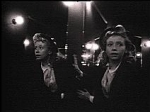
Segda as Lili
|
Weininger makes an appearance in this beautiful film as an endearing jackass. Let me explain… Most critics are baffled. There is a thin story of once separated orphaned girls again united and a lot of disjointed, if evocative, imagery, but nothing much seems to bind the film together. The girls, Dora and Lili (both played by Dortha Segda as adults), are born in Budapest twenty years before the turn of the 20th Century. Selling matches a few years later on a snowy street at Christmas, the girls are abducted by two men who carry them off to lead separate lives. By 1900, we encounter Dora as a cooing coquette aboard the Orient Express seducing men for pleasure and money. And Lili becomes a hapless revolutionary, climbing factory smokestacks to scatter political flyers, which gets her sent to Siberia for a spell. Both end up having affairs with the same man, unbeknownst both to them and to him. When Lili returns from Siberia, somewhat chastened perhaps and regretting her refusal of his advances earlier, their affair is rather badly consummated. He had mistaken her for her sluttish sister, Dora, who had already instigated her own consummation with him. Lili, in desperation, attempts to take up political assassination. She loses her nerve at the last minute, running around with a lit fuse (which, we are relieved, goes out before she gets blown up). She ends up in a carnival house of mirrors where Dora too has gone. A donkey leads their lover (Oleg Jankowski) to the same house of mirrors where he finally learns they are two, and somewhat sadly witnesses their joyful reunification. So much for the story. But now for what intrigues about the film: Interwoven are a series of cinematic vignettes involving an escaping laboratory dog; a talking, singing, teasing Greek chorus of night stars; a zoo monkey's tale of captivity; an almost angelic facilitating donkey; a celebration of Thomas Edison and his inventions—electric light bulbs and the first round-the-world electrical transmission of words; and a pathetic lecture by a certain pro-suffrage, anti-feminist Otto Weininger to a gathering of Hungarian feminists… The film culminates in a stunning, moving camera shot of a fast receding horizon viewed through the mouth of a long-constricted, tree-banked estuary, broadening finally into open water. (A hint as to what the film is really about.) The film is shot in black and white using an "academy ratio" for the boxed screen, common to both TV and old silent films. As one reviewer noted, except for the sound, smooth camera tracking and lack of scratches, you might think this film really dated from the time it depicted. The film—in case you haven't guessed by now—is about emancipation. It is about the promise of the century for women, about their self-loss and self-finding. Early on separated, leading confused or dissolute, hapless or dissipated lives, the twins do, in the end, find each other, and out of this, perhaps, a new meaning for themselves. Central to understanding their self loss due to men is the lecture by Weininger (played by Paulus Manker, who has also portrayed him in the play, Weininger's Last Night, by the Israeli playwright, Joshua Sobol). Lili attends the lecture, and while the other women leave, one by one, in disgust, she stays on, realizing the truth in what Weininger says despite his "crackpot" portrayal and his apparently cliché-ridden theories about women. Unfortunately, only seeing the hysteria in this scene, most reviewers fail to see it as key to the film. Lili's face clouds with devastation as she listens intently to Manker's character spouting off the most unvarnished Weiningerisms concerning the purely sexual being of woman: her soullessness, mindlessness, and amorality; her essential nothingness, using crude chalk board anatomical sketches to dress his theory with a semblance of biological authority—all to the open derision of his audience of women. (We are not aware of any historical evidence that Weininger actually gave such a lecture to such an audience, but it is fun to imagine what it would have been like.) But the earnest Lili is stricken by what she hears, realizing her own ineptness at social and political change and how constricted her fate seems to be. Meanwhile, her sensuous sister, Dora, exploits to the hilt her female sexual power and the corresponding male weakness, stealing money, jewelry, and perhaps a heart or two. She is the living embodiment of one of Weininger's two essential female types, the prostitute. Otto Weininger, of course, did not—and could not, given the rigor of his philosophy—blame women for being what they are. All blame, precisely because of the amorality of woman, is to be placed squarely with men. It is, in short, the responsibility of patriarchy. All criminality is theirs. For Weininger, the real emancipation of woman can only happen when she becomes conscious—and man lets her by stepping aside—of her own integrity altogether different from his. As long as she is imprisoned by man's ideas—which were created for his own purposes, not hers—she will continue to struggle vainly in the darkness of non-being. Thus, the very concepts of mind, soul, and morality are radically foreign to her. Deep down, they are not her concerns. They are proprietary male obsessions. (Closely examined, those concepts and others, as used by men, are fundamentally at odds with any comparably important or resembling terms used by women.) Thus, Weininger could be both pro-suffrage and anti-feminist without contradiction. Pro-suffrage, because suffrage has to do with empowerment in a material world—a place in which the male is, in his heart of hearts, not a happy participant. While this is in fact the primary world a woman lives in. Earthly power is very properly hers; it becomes her. Anti-feminist, because, to the extent feminists confuse what they want with what men have in terms of mind, soul, morality, etc., they are victims of a half-realized male plot to keep them in their place. Men know they will always be the ones to define these terms, for they created them from the beginning. If only men can be moral, it is because only men need to be moral. At these pursuits, men know they will always outclass women (and make women feel inferior), for men are driven by death and women are not. While it is not impossible that a woman chooses to be driven by death, it must always seem inconceivable to her…. (We only brush the surface of Weininger here since the complexity multiplies when we introduce to the mix his theory of the mongrel nature of both women and men and the internal competition of principles in each.) Male genius is indeed driven by death. There is a sadness in men because of this, a darkness that breathes in all the light and greatness he is capable of. Thomas Edison, the other genius appearing in the film, is celebrated for his electric light at the beginning, and at the end for his telegraph, each time his face solemn. Even the chorus of stars, whose visibility he diminishes forever, remarks on it. For there is also the pain, loss and suffering he will bring about through his inventions. The laboratory dog was wired for electrocution—many animals, even elephants, were sacrificed merely to show off to the world the power of this newly discovered, male engendered force. Later men will be electrocuted in state-sponsored rituals of moral hypocrisy. But this one fairy-tale dog is saved when the stars coax him to escape with cinematic images of chaseable cats, the world and freedom... Men deceive to imprison. As he watches Lili and Oleg watch him, the zoo monkey recounts the entrancing faces made by the hunter in the African jungle who captured him. Lili is in danger of being entrapped by the man she is standing beside who does not understand who she is, in part—but only in part—because she does not yet know herself. In the house of mirrors, the sisters meet in ecstatic recognition—portending perhaps some hope for women in the, then new, now past century. And the men? The nameless lover (Jankowski), Edison, the hysterical Weininger? They remain sad onlookers to this event—well, all except the possessed Weininger, for he was not quite an onlooker… The symbolic coup de grace of the film is the donkey, facilitator of truth. As match girls sleeping in the cold, Dora and Lili had dreamt of an ass carrying them off to a place of light and warmth. At the end of the film, the ass reappears, and by stealing the lover's hat lures him to the house of lighted mirrors to witness the reunification of the twin sisters. Recall here that it is men who were the intended target and audience of Weininger's treatise. It is they and only they—because of their self-ascribed attributes so lacking in women—who can be held accountable for their hypocrisy. The jackass is Weininger.
Copyright © 2001 Iaia Gombrowicz and Victor Muñoz |
Written and Directed by
Ildiko Enyedi
Cinematography by
Tibor Mathe
Edited by
Maria Rigo
Starring Dortha Segda, Oleg Jankowski and Paulus Manker (as Otto Weininger)
Hungary, 1989
Cannes, prix de la camera d'or, 1989

Ildiko Enyedi
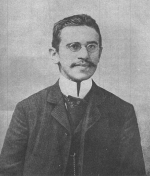
Otto Weininger
(1880–1903)