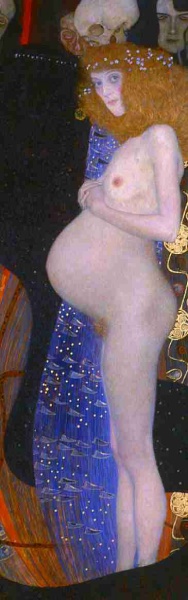
Gustav Klimt's Hope I
by Johannes Dobai

According to his friend Ludwig Hevesi, usually a reliable source, Klimt painted Hope I during the summer of 1903,.... [Weininger would be dead in October.]
One may...see Klimt's Hope I as the expression of a view of life derived principally from Schopenhauer—an artistic presentation of misogynist and pessimistic ideas related to Klimt's Judith, which, significantly, also bore the title Salome at that time. … In this sense one might say, "To Klimt's Judith must be added her pendant, Hope, in which one fears that the child of Satan's plaything will be stillborn".... The background for such a view of life would be the ideas of a younger contemporary of Klimt, Otto Weininger, whose Sex and Character was in fact published in Vienna in 1903 [in May], the year in which Hope I was painted.
He posited a philosophical Counterpart to Franz von Stuck and Gustav Klimt; Man represents the virtuous, the positive, the creative; woman the evil, the negative, the destructive.* All human conditions result from man's bisexual character in consequence of the interior struggle between his natures.
.... According to this interpretation, Klimt's paintings would be fundamentally pessimistic in content—a way of presenting the physical aspects of the senseless continuation of a mankind rotten at the roots, in the shadow of monsters and of death. …
Quite a different, much more optimistic, positive and, as will be shown, progressive interpretation of the painting is given by Klimt's friend Ludwig Hevesi, although he was sometimes inclined to idealize Klimt's work.... As mentioned above, he revealed in 1905 that the painting was protected by double doors in the Waerndorfer collection, and gave a plausible interpretation of this work, locked away from "profane eyes":
The painting is the famous, or should we say infamous, Hope by Klimt, of the extremely pregnant young woman whom the artist dared to paint in the nude. One of his masterpieces. A deeply moving creation. The young woman walks along in the holiness of her condition, threatened on all sides by appalling grimaces, by grotesque and lascivious demons of life...but these threats do not frighten her. She walks unperturbed along the path of terror, spotless and made invulnerable by the "hope" entrusted to her womb. A symbolic painting—in which the theme of Albrecht Dürer's Knight, Death and Devil...has a modern ring—has been cast into a sensitive, romantic form at a time when all ideas of emancipation come together. Naturally the muse of prudery has banned his paintings and condemned the artist to a hundred thousand years ill [sic] purgatory. At the Klimt exhibition two years ago the painting could not be shown; superior powers prevented it....
Johannes Dobai. "Gustav Klimt's 'Hope I.'" National Gallery of Canada Bulletin 17 (1971), p. 2-15, 33. More...