
« prolegomena
Bianco Luno
Notebook VII
9/15/90 – 4/13/92
Part 1

|

|
|
|
|
|
|
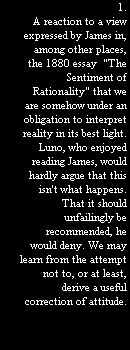
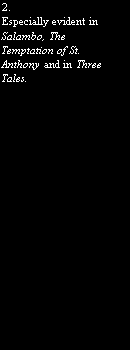
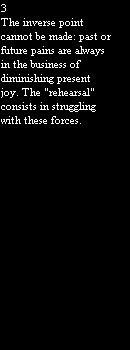
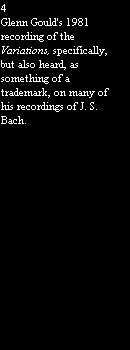
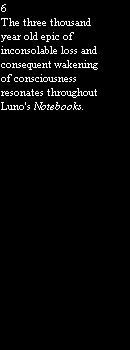
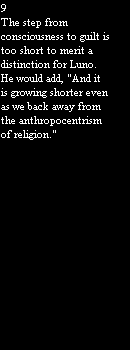
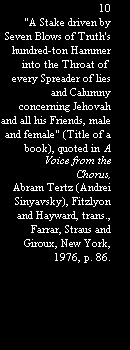
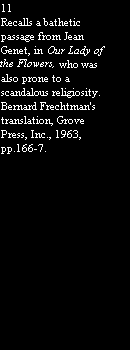
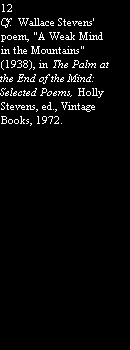
To William James: I am not allowed to work out my bleak logic without suggesting some way to avert what it describes. I don’t profess to be an example for you, but I offer this counsel: without turning your face away stop seeing it as bleak.1 ~ I have Flaubert’s fascination with and shyness toward religion.2For the sake of what little purity there is in it, I might have slaughtered half of Christendom, beginning with myself. Actually, myself would suffice. ~ Between profound prejudice and a saturated confusion, foils for each other, the drama, the thaumaturgical play on emotions, the rest follows.Not ideas, there are no ideas, only murderers and victims, hate and fear...the rest of the time we ‘enjoy life’, that is to say, rehearse enjoying it. A cheery view. Because it endures suffering at face value, stoicism is a sham. What do you call the opposite of stoicism? Whatever that may be, it is also a sham because it doesn’t face the finality of suffering: no past or future joy can erase pain now.3 Time, invented to this end, erodes the basis, grinds to already forgiven pieces the occasion. ~ Last night, again, a dream:Atop a mountain peak, the abyss all around growing because the peak I stand on keeps getting sharper. So needle-sharp, I will be impaled through the one foot on which I’m balanced. Lightning flashes in the background. (A cartoon, which I don’t even remember liking: Rocky and Bullwinkle.) My ‘philosophy’ self-caricatures. An averted pregnancy, a menses, a masturbation. What does it have to do with health or even resignation? A pussy exudation: soak it up. I am hardly an existentialist. I am a bandage, a sanitary napkin ...because the peak I stand on keeps getting sharper, sharper. ~ Epistemic states oscillate between prejudice and confusion.All else is spite. ~ Pain and beauty.The beginning and end of the Goldberg Variations and Gould’s humming, barely audible on these so soft endpieces.4 Struck dumb from pain, a whole philosophy is developed, from the first stirrings of doubt through despair to resignation. Truth having never made an appearance. The history of philosophy in 33 chapters. ~ To speak the truth is to hum.(How we do it in the West; maybe, sometimes, we also whistle.) ~ I have to speak this way, do you understand?Not sure why I embroil my personal defense with ours before an empty bench, as though it were some final ‘hope for humanity’. ~ I could tell you how uncomfortable I am with the shape of my nose.If you saw it, you would respond considerately, saying perhaps that most people have awkward noses, and you would miss my point. Where is their discomfort? Even people with the most perfect noses are uncomfortable with them, you were going to say? "What discomfort? Spare me, no, you mean just this nose, your nose, your personal sore spot, is what makes you an Kierkegaardian ‘individual’, with a skin the color of no other, a one-person race, and you a racist. Yes? This is what you tried to mean, but didn’t: you were not up to meaning anything. What I am going to say to you is the truth. (Please hold back your knowing smile for the moment.) Your nose has nothing to do with anything. You are enchanted with jealousy, other people’s noses, notwithstanding. If you had no nose, your ploy would be different but your snot the same, only more accessible. Then, your rhymes could come to rest on your physical deformity. As it is, your deformity is invisible. I could discourse forever on the nature of this invisibility. You are so patent, such a perfect backdrop to everything that happens around you that the most inconsequential biographical or material fact about you will loom smaller than your impossibly microscopic ego. You began by saying you had to speak this way, but you lie. Your speech is hardly within the range of hearing5, let alone distinguished by some special quality. The casual assertion of godliness only clinches the matter: carry on, call yourself ‘God’..." ~ From under her skirts, the boy makes fun of the woman’s indignation.A sucker for innocence, whose true enemy has a body covered in down and a voice of a still purer soprano. ~ But men are truly disgusting creatures, one can hardly blame her.But, again, disgust is connected with power and to be so invested is to have maggots teeming in the soul. ~ I met Jesus yesterday on the street.But for the fact that I knew it was him, I never would have guessed it. He smiled, walked past, knew I had recognized him. I saw Jesus, my son. ~ Marx and Smith and the division of wealth.Contemporary therapeutic psychology contends with a similar distributive problem in the concept of ‘empowerment’. Self-interest is as much a canon as altruism, as much an excuse, and as deadly. I have never been able to ally myself with a scheme for the division of wealth. Psychic, no less than economic, victims of abuse are too apt to adopt their oppressors’ standards. I refuse all solutions, and so it appears I support all sides, or none. ~ A saying among logicians, "one man’s reductio is another’s modus ponens": having reduced an opponent’s argument to absurdity, the temptation to swivel to an alternative conclusion.Against this psychological bent in logic I struggle. A reductio leaves us with ashes. The Phoenix-like inferences, you see rise, are moist apparitions, tear-ghosts, every bit beyond your will as the estimious sentiments evoked at a proof’s finality: quod erat demonstratum. At the top of the mountain, over the grated pit, the vulture-logician picks corpses clean. When the pieces come white and slip through the grate of the Tower of Silence, I enter to cart them away and build a cage with them, which one day, when large enough, will house the moist apparitions in a sort of zoo for the edification of the plain and simple person, the unborn, and for the kind eyes of God. ~ The age of therapy—inaugurated by Freud, etiologically dead-ended by Wittgenstein, et al., early heralded by Hume and maybe Pyrrho, vermiculated by Foucault, Derrida, and friends, (why stop here? why not include everyone in the history of Western literature and philosophy since Gilgamesh6 and Enkidu?)—is soon to be superceded—not for lack of imagination on anyone’s part—by an age of spite, resentment, by an age in which a surfeit of pride makes the sick hold their heads up high and the cured higher still and the-never-having-been-afflicted able to see to the ends of Alexander’s estate.Finally, by an age of old age. ~ This knowing about everyone but ourselves is what is meant being a ‘social animal’.We are best groomed by others... It strikes me as sad. I am not made to feel closeness, or I feel that closeness as suffocation. Your ambition to see my condition eased...well, do you see what I mean? Wittgenstein spoke of the experience of feeling "safe"7 as though it were some profound discovery at the bottom of ethics, as indeed it is, despite what we are asked to believe. But for me, it is too quickly followed, not with the accepted emotional valence, not with warmth, instead with an extreme breath-sucking heat, but not... My illness, if you wish to call it that, stems in great part from your wishing to make me well. (A thousand years ago it would have been unmysteriously labeled ‘sin’. What do you suppose we will call it that long from now?) ~ What do you think I mean by insulting God?(The compulsion, I don’t fully understand.) I think of him every moment, so much is clear. Piety?: But for the fact that he has no right to exist. ~ Someday, it’s possible, I will feel closeness: you will have to lend me your imagination.~ Partiality toward blood- or familial-ties is not (except in democratic politics) judged another prejudice to uncover and expunge.Should we ever though, then we will have to crack down on emotional ties. ~ Fellini, my cat-friend, is teaching me closeness.I’ve never met anyone who, by their willingness to be observed, has more convinced me that they are capable of loving. How to explain this: their powers of persuasion are inadequate, or my discernment, or I am looking in the wrong place altogether: I should be observing how an animal might favor them. It is a quality that can only be observed in a flawless mirror, not directly, no matter how closely. ~ The motion from the irrational to the rational is the classic move in art.The movement in reverse is romantic. Not either alone. It is clear system-building or reductive philosophy is a species of the former. And the better part of the time what I am doing is romantic: showing up reason’s pride, wallowing in the ridiculous, making toasts of hemlock, etc. Every insight upon being made clear is, in virtue of this clarity, false. The paradoxes that ensue from self-reference indicate the place of the absurd and the places where we are comfortably sane, literate, judgmental, and the principle source of presumption in the universe. But art could never be content being in the service of anything. Like a murderer, with a slit to the throat, it must drain the color from your face. How little this matters to the fact of our lies and their capital deserts. To death, if we should think. And if we take care not to, we deserve nothing, whatever we may experience. The importance of art is that it permits us a moment or two of what it is like not to think, and not to deserve anything, to re-experience being adiaphorous—reason enough, in itself, for common morality to perceive it as mortal enemy. ~ Equally fickle in their development, moral and aesthetic values—but the latter travel in circles (wide arcs from our perspective).Both move, a possible and ominous surprise to some about ethics. The moral is linear, "the straight and narrow", and like an arrow in flight, it is displacing, moving with a very clear (if, just the same, highly deniable) direction. A vector, aimed at the Good, the Ultimate Good, that is to say (that is to whisper), Death. So the commandment, "Thou shalt not kill", has the suppressed qualifier: "all of a sudden". In due course, without impatience, and with respect for the moral order, which is not the same as ‘upholding’ the moral order: it has us firmly by the scruff and scarcely needs our complicity. We are only free to march to the scaffold like, deep down, the good aristocrats we are. But the history of art are the paths traced by stray balloons through the vapors, squatting over the moribund city, and though there are infinite reasons to, we are not rational and so there is no requirement to be sad. The joy of death is difficult to celebrate but the muses do not skimp on supplies. To sum up the Decalogue, trite in its profundity: "Be a good sport about death." ~ "What a jerk! A snide-ass tease, waving your perfumed pussy around!"—to paraphrase a male friend of O’s on reading some of this.Perfume? The logic of perfume would be a fit subject for a poet-logician. ~ The expected immediate reaction, when most resisted, is infuriating to all but the dead and their emulators.How should I react, not sure which camp to pander to? The Christian precept—turn the other cheek—is the most offensive, virtually obscene, gesture I can envision.8 This Jesus was a liar in his heart. I don’t particularly mean the historical Jesus: I could say as easily "Nixon was pure of heart", with the same accurate intent. You may have an image framed in a tidier portion of your memory—that Jesus was a liar. The historical figure, like this given woman or that man, is barely interesting to me. My criticism is of archetypes and their attendant tropisms. Take any man or woman and my hapless idiot compassion would forgive them murder in the stark glare of the knowledge of their consciousness-mongering guilt. That guilt, which if you presume yourself Christian, can easily derive from well known premises; if your curiosity is paganish, you will have noticed that death, combined with naturally occurring compassion, is one of Nature’s greatest triumphs. An attempt to deny this is only human, consequently, more cause for guilt or consciousness (the newer term for the same)9. And you will notice where she, with Draconian inferences, steers the argument: toward the compost heap. Perforce, if your curiosity is unbounded, how can you avoid having death’s stake driven home with "truth’s hundred-ton hammer"?10 ~ As logician the imperative is to labor the obvious; as poet to make it cryptic.~ "What is so much gall in the service of?" Really, I don’t know.Something I haven’t learned, or can’t, haunts me continually. ~ Why can’t I learn from others?The form my question invariably takes on. It is as though, outside looking in, I’m not able to covet appropriately the visible beatitudes. Acutely aware of where I am, I am blind to the brightly colored passions so necessary to the faces worn by others. How express or how express enough my native repugnance for the alternative, the going back—for it does seem to me ‘a going back’—to these vivid colors. It is natural, I claim, for me to feel this way, notwithstanding its contrived refinement. I try to keep in view the horizon of the direction I am facing and have no illusions that it isn’t freed of color and, mildly put, black as death. I will not accept that dignity is a fair trade for passion—for it is not. I am not going to pretend to any superiority: I can match their appeal to elemental forces in Nature with a set of my own (she is perfectly content playing both sides), but that is as far as I dare. It is too easy to see my place in the larger scheme. It is very easy not to—or to keep running up the same tree, replete with the same inconsequential fear. This appears to be what I am doing just now. I detect that I am moving slower, glancing back at the cat over my shoulder with a growing sympathy for him—fatal or not, flaw or strength, uncertain. ~ "You seem to want to side with oppressors against their victims?"The best I can do, by way of explanation, is to note lamely that every oppressor was and will be again a victim, hard as it is for the presently oppressed to consider. What hater would listen to what I say? They would listen as carefully as some Nazis heard Nietzsche. I ask you to show more discrimination than is generally expected of you or you customarily credit yourself with in polite company. I speak up to you. You don’t deserve it, but, in the nature of the case, I have placed myself beneath you. The view from here you will never grow accustomed to. ~ Compassion.How could Jesus have imagined asking that of us? ~ Grist for your mill.I have sexual feelings for the mentally retarded women I work with, for most young girls, some older women and even certain species of plants, however, my homosexual development was early somewhat arrested, and animals yet don’t do much in that regard for me. Serial killers obsess me; I catch myself, often unawares, picturing people I pass on the street in all sorts of colorful agony. I ponder how very adventitious the distinction is between eating and killing, mishap and murder, the private parts of females and public parks... Put me in Hitler’s place and it probably wouldn’t be Jews—but I would think of some group... No confession intended. That more than anything galls you: that I should think that thus I am fully qualified to speak of you. ~ Among locally oppressed groups, blacks, animals and the retarded are least suited to this status; Mexicans, women and forests most suited.You oppress us further by lumping us together. ~ "You will be misunderstood."How is that possible? Upon first opening its eyes, will a child accept everything it perceives, or does it mistake reality for something else? There is no other way but literally to take me. Truths are inveterate killers; they systematically kill each other, and each kills and kills until it is killed. The last truth is a laugh, entitled to a figure and ripe for misconstrual. ~ You observe, I rarely talk about ‘justice’.Be assured, I’m not going to start now. ~ For all my solipsism I am remarkably unprivate.I never confess personal sins or secrets, without having first to implicate you. I deflect personal responsibility by declaiming our conspiracy. In this way I can move from the smell of my own farts to the glory of God.11 I am not to be trusted; I will stab you in the back the first chance I get. But my perfume is a real lure, isn’t it? Why do you keep coming to me? Why are you so weak? ~ History and mathematics.Less pain per se is caused by immolating two people than by starving one. It takes many more gassed to equal one starved. ~ A soft dew and the patience of eternity may overcome a "hundred-ton hammer".How many people in the world knowingly starve themselves? How many starve to death? ...then, who starves them? ~ The compunction to shield from horrifying thoughts, art-objects, substances, experiences...:small children and women...If I didn’t feel that an eight year old ought to be introduced to pornography at the first spark of curiosity, toured through a slaughter-house as part of a school field trip, permitted to drink and drive, make free use of any mind-altering substance or medium (e.g., television) as might encourage them to dream of worse things, witness an execution or shadow an ambulance—if I might have my way and every child learn by watching its parents copulate about the beginning of its history, and curiosity only determine not just which but the order of its objects—if I expected much result from this, then I would not object to the request that my writing be more accessible. But although I am able to vouch for its usefulness in a small chamber of my heart, I expect it everywhere else to convey back to the keen ears of haters the sympathy scrutable in the lined faces of the "innocent" and "sensitive", who alone can appreciate what horrifies and outrages; the others, who define and hoard "horror" and "outrage": poseurs all. ~ While I do not easily suffer from an -ist attitude, I am susceptible to the autistic disorders that assail estranged existences.~ I used to notice more.My sight is not as impressed as before by what is commonly in focus for us. I see patterns pretty clearly. Answers crowd my mind before a single genuine question can enter. Before the fierce white light cauterizes her retina and renders her sensible, a mad person must cup her hands to her eyes to hear. ~ A little bit of sexism."They don’t need your sympathy, they need your humiliation. Learn to crush all that makes you most male. How can you maintain your dignity in the face of that? Your dignity is the very thing in the way. Be crushed and you shall crush, and you must crush what is male in them to have yours vindicated. This can only be achieved by a kind of spiritual self-violence, though they—being what they are: averse to sudden movements—will not stand for this. But always remember, be courteous, for even if you fail at the bigger task (and you will), if you do this at least, you will be well thought of. And isn’t this what you want? No? Tell me, you pathetic creature, you." ~ Metaphor for Rationality: A Ticking Clock.Each piece of the finely wrought mechanism, working through the properties and the permission of matter, of physics, does its job, what it was designed to do, in a way we are drawn to admire because we (like it) are such small creatures in time which almost casually—in return for being measured—will (and also not without its own grace) confer upon this machine a last conscious moment then recover its parts for itself. Now logic, it is in respectable quarters assumed, is as reliable a guide as we may possess to the better understanding of what happens in time. It is the most reliable thing in the universe, I think. (Reliable, as though this had much interest for us.) Like this clock, it attempts by taking the measure to possess what destroys it. It is the most reliable thing in the universe, all the same. For what is time? What does it promise you? Why do we expect it to stop for us? ~ Some persons have a moral right to oppress others; you will reckon which those are.We need hope they are compassionate, or at least informed by a passion of some kind or other for us to curry. Why can’t I take comfort in the laws of logic or morality or even a historicist’s conversation? I think I am broken or misbegotten. Don’t dash my hope—contra-indications aside—that you maybe aren’t. I stroke my cat and begin to weep. I revert. I become the emulsification of holy water. My body aches. I believe that even in death I will know pain. Because I don’t know that it (death) is sufficient to kill off the knowing smile, and because, while alive, I never learned to smile properly, according to custom. I can’t experience even self-pity as the handbooks say. My tears must not be real: blood of the mind or something.12 ~ How come I never talk about what I had for breakfast?Or the fact that usually I write in this little notebook in a university cafeteria against a din of slapping trays and scraping chairs and a beach of conversation. Sometimes I write at work surrounded by small children in big bodies. Or the weather?... I do mention my cat; he breaks through but little else. But is this true? More used to. I talked about a flower box I made once, about the people I shared a house with, the old ones at the retirement home, the people I met hitch-hiking, spring walks in the parks, at the market, by the lakes... (Didn’t I recently mention Gould’s humming?) What has happened? Nostalgia is disquieting, the future plastered with fate, the present insists always on being bearable, doesn’t it? What else can I say about it? (A wisecrack peeks around the corner.) ~ The soft rose complexion of a woman’s face.(You will want to know—but I won’t say—which. It would invite misunderstanding. And on this subject we can always use more, no?) An older man’s reaction to it. (A younger one’s would be seamlessly connected with it.) To put a finer point on it: he could be moved to tears by the sight but it should still be called rape and he should be punished accordingly. His eyes should be gouged out. ~ The only people who have no right to an opinion about rape are the fathers of daughters.For similar reasons, mothers of sons, gone off to war, on war. ~
Copyright © 1998 Bianco Luno and Victor Muñoz |



Part 1
|
|
|
|
|
|
|
|
|
|
|
|
|
|
|
|
|
|
|
|
|
|
|
|
|
|
|
|
|
|
|
|
|
|
|
|
|
|
|
|
part 2 »