« part 2
Bianco Luno
Notebook VII
9/15/90 – 4/13/92
Part 3

|

|
|
|
|
|
|
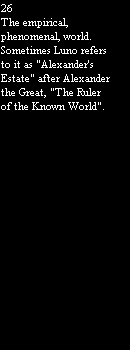
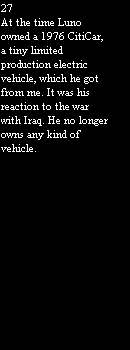
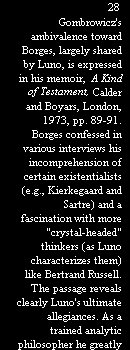
Today, Valentine’s Day, a man called to say to me, "It would be nice to have your hard dick in my mouth." He also noted that my voice was soft and sweet, etc. He said his name was Michael Anderson... A trampled nerve. Maybe I understand (a little) what it must be like for a woman. I think hardly past this experience this day and the next. I was aroused enough to be depressed, but what else stems from the humiliation? That I have a sufficient presence in the world to be victimized, that someone out there could peel back even a corner of my self-regard? How can I avoid using him as an occasion? What if I had been raped? The way I would have tilted my head looking at the fallen pieces... Michael will never read this, will go on thinking my voice soft, sweet... ~ A man plopped a card on my table with the American Manual Alphabet for the Deaf on one side, and a smiley face and "I am a deaf person selling these cards for a living" printed on the other.As he made the rounds of all the tables in the university cafeteria, a manager accosted him and asked him to leave. The deaf man made a loud protesting sound that turned heads, and the manager, frustrated and momentarily swollen in his role, raised his voice for all to hear (who could): "I don’t encourage anyone to give this man money!" I don’t know if I would have left the man a dollar on the table if the manager hadn’t asked me not to; but this is the form charity takes in me. Only tell me that the beggar will drink himself stupid with my spare change and I find new reserves of compassion and aggression. If you were drowning, I would probably not stop myself from helping you, but it would be foolish of you to thank me. It is because I think you know this already that being helped is so humiliating. Thus, the undercurrent always justifies ingratitude. ~ How could I avoid reacting to you long enough to say something true?The person I am in your face and in what I manage to reveal here both stumble through effort. Yet each meliorative or integrated instance of what is called "healthy" in this matter is inutterable stupidity. I don’t see a way out. Even acceptance of this fact is a last dream of the dying. ~ I don’t impugn Hope because it is false (that would be ceding it too much) but because it arises from a decaying integrity, because it is morbid.Where do I steal the right to rail against the morbid? (At what point do these questions turn silly?—but if they ever become that, they were so in the beginning and, again, I run up against stupidity, the spitting image of which I observe just now, watching a man, standing in line, making faces at a woman’s child.) ~ In this series of masks, which you readily acknowledge as that, what determines which pleases you?Your interest lights upon one from time to time, is repelled by some, indifferent to most...yet this one or that will eventually mar the polished surface of your consciousness. They all stop too short, too short of expressing a small ordinariness. You will not so readily acknowledge this. That at every point I am unremarkable is a lesson presented to your judgment. ~ You cannot have it both ways: either I am peculiar and dismissable or ordinary and unsettling.(Said this once before.) ~ She would have me incorporated, re-embodied (assuming I was ever), reabsorbed, as it were...my choosing to play out of her sight is discomfiting to her.Coy, cryptic, and, as a consequence, erotic, we employ a similar charm, are subjects in competition for the same object: to seduce in order to betray. ~ Logic may govern the relations among the propositions that are objects of our beliefs, but it is the etiquette of faith and, like all etiquettes, it is, in the first interests of life, dispensable; we need not stand on it.In fact, we gain integrity, a certain wholeness or decency, by losing it, but at the cost of also losing the righteousness that paradoxically, when rigorously exercised, accomplishes a more advanced integrity—an integrity farther along in some direction. I won’t say which, only that nothing written anywhere on the sky or in the earth or any part of the empire26 indicates whether we should rest here or move on. But since we must, one or the other (logic insures this), the future is so frighteningly clear that we are disposed to be blind to it. ~ It is the man who makes faces, the woman who owns the child, and the child who must learn from these two!(I can make faces and say idiot things to my cat but he will not learn from me.) ~ I see everything as on the verge of befalling me.I am terrified, so I am arrogant. ~ A kind of murderous, diffuse suicide.Out to destroy myself in you or anywhere I see my reflection. So little of me left here. ~ Almost one half of who I am I will never be able to write about in these pages.That part stands in absolute opposition to the reason, grammar and morality of the language. I can tell you best about it by describing you. ~ If I keep mentioning ‘you’ enough, it may occur to you who I mean.I needn’t identify you more precisely than as my little voyeur, my sweet beleaguered reader. My ego performs its lude antics for your salacious pleasure. Together we mock the morality of the language. All bare-assed reference with no meaning. I could clothe my ego more congenially, tell you who I saw today, what we discussed, what I did, what happened to me, what affected me, mention a few people other than myself, describe them, show some imagination understanding their predicament, be kinder to their politics, their loved ones, their jewelry, drop the snideness, fake some good humor at least, try to recover my gift for depicting the bucolic and picaresque (long, long ago I was obsessed with the evocations of mountain flower names— "rose pussy toes", and cataloging gumspots on city sidewalks)... My sentimentality indulges itself now only through occasional reference to my cat, the sole remnant of a failed relationship... But tomorrow I go to Lucia di Lammermoor with O just after we dine at the Bamboo Garden, a Buddhist, vegan Chinese restaurant. This morning I did a load-test on the batteries in my electric car.27 Next week, with the new quarter, I get busy tutoring logic again at the university; and, as for the last several years, on the weekends I go to work at a group home for developmentally disabled adults, etc.... But behind all this cheerful activity, the sad indolence of a trapped spirit, a cowardly wad...and the violence there, sprung and trembling, should come as no surprise. ~ Why have I made a virtue of holding together the pieces?The godless, pointless state or process of things could not care less. ~ Reading this, Gombrowicz would have found it (at best) too Bach-like in its mathematical precision and distance, less sissified than Proust but just as shut in."Values are formed in the space between people" and I am reluctant to stray into this space. It was his thought that in their redefinition or in the attempt to redefine them some salvation might be had... The contrition or mystical repose of Bach or Borges28 slightly affronted his mercurial uneasiness; the yearning he discerned in the last quartets of Beethoven was more congenial. Perhaps because I am not a musician or because Bach was not a writer or thinker I can impute to him almost a plumbless, magnificent depth. Similarly with Borges...until I consider what he said in interviews and am reminded of how desperate I must have been to share in his enlightening imagination and in the confidence of his repose. Or when I recall Bach’s 22 children and how simple a man he must have been... I do not yearn for simplicity, or if I do, only in moments of undignified despair, when the knife in me is twisting. Pain, which the cello suites help with, keeps me yet from resignation. What is my relationship to pain? Do I really want it to end? What would end with it? We are most vulnerable to contrition not when in pain but during the first few minutes of its subsidence, while the pain is paused but memory is still fettered by it. ~ "Why the two-facedness, why don’t you express your true self in public?" You want to live (as all arrogant things do), and perhaps so do I.~ Practice that look, smack of lips, matronizing censure, the seed of a certain violence, of a kind if never against the deserving mother then the next most available female.~ A third path?Either we overpopulate ourselves to death... or we premeditatedly underpopulate ourselves to extinction. What makes moderation seem credible? Our instincts rage uninterrupted in the first direction, but ‘consciousness’ has at least dreamt of the alternative. Aristotle’s ideal of moderation is no less a pipedream than Plato’s tableness, his chairness, etc. Where in nature do we find temperance persisting over time as something other than the lowest point in a pendulum swing? When does it stand still? (While continuing to breathe.)
Is it the affliction of the asker of these questions that he keeps slipping outside human time, pretending to a view sub specie aeternitatis, betraying his spiritual, unnatural leanings? ~ How do I back off from this precipice?Nostalgia, jettisoned some time back, it isn’t as though it were a matter of retracing my steps. ~ "You have no vices."But, I do. I have bad thoughts, worse than anything you could commit with your hands or lips. ~ Before we were born we were shown vastly different pictures of what it would be like.Yours must have come closer. It has to be said for it, though: my vision, however little there has been to remind me of it since, has continued to color, that is to say, darken my perspective. This through some vivid virtue of its own or some gift for compensation of yours or shortcoming of mine. ~ Imagine the evil roiling in the heart of the medieval liar and thief whose arms were cut off and tongue ripped out.~ Maybe I was born blind.
Editor's Notes A reaction to a view expressed by James in, among other places, the 1880 essay "The Sentiment of Rationality" that we are somehow under an obligation to interpret reality in its best light. Luno, who enjoyed reading James, would hardly argue that this isn’t what happens. That it should unfailingly be recommended, he would dispute. We may learn from the attempt not to, or at least, derive a useful correction of attitude.
2.
3.
4.
5.
6.
7.
8.
9.
10.
11.
12.
13.
14.
15.
16.
17.
18.
19.
20.
21.
A. I am Alexander the Great This version of the anecdote is from Herakleitos and Diogenes, trans. by Guy Davenport, Grey Fox Press, 1979, p. 44. The story, so emblematic of non-compromise, is a frequent reference in Luno. He probably first became acquainted with it in Kierkegaard, another fan of the "Socrates gone mad".
23.
24.
25.
26.
27.
28.
Copyright © 1998 Bianco Luno and Victor Muñoz |
Part 3
|
|
|
|
|
|
|
|
|
|
|
|
prolegomena »