« caveat
The Philosophical Notebooks
of Bianco Luno
Prolegomena
|
I don't wish to speculate on what tick in your mental make up or history
has prevailed and made you read this far. Curiosity is never completely
idle. That be as it may, I will try to explain something about the writing presented
in these pages. But in what follows the element of coy warning persists.
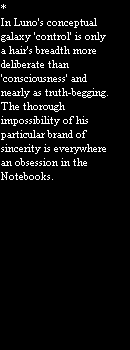
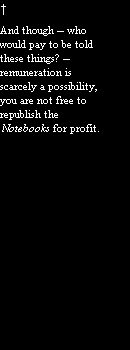
The Notebooks are the detritus of one extraordinarily conscious mind marking its way through existence. Extraordinary, because it is rare in literature–even in philosophy (where one might expect most to find it)–to see the notion of consciousness pursued to its bitter end. Too often a thread of hope or faith is salvaged for the convenience of living. Mr. Luno would respond to the inevitable query "why 'too often'?" religiously, by asserting that our existence must have its meaning, if it is to have any, outside of itself. And of the possibilities there, the one that rests at the edge of the senses and their pragmatic convictions is too brutal and, however correct, lacking in grace. Resorts to the supernatural, however understandable, can be only the most explicit forms our capacity for self-delusion takes. Finally, agnosticism is a lie. We know–we know only too well–what it is that underpins both our fear and its pandemic suppression. God's existence is as utterly absurd (Kierkegaard) as his absence (de Sade). Most ridiculous of all: our penchant for imagining otherwise. (By 'God' Luno always means a personal, intelligible being; any other conception is a stand-in for a heuristic term from physics and of small interest to him.) Bianco Luno worries his special form of destructive dilemma and all its implications, like the paper napkins he carries in his coat pocket, into pulpy shreds, the nervous sculptures, the mealy fragments of writing you see collected here. He cannot bring himself to expound his philosophy with anything approaching seriousness in longer more structured compositions. He perhaps once himself suffered from the belief that spontaneity is in some way a necessary condition of truth or that it is a way of cheating consciousness of its ulterior machinations, that truth, thus caught unaware by a nimble, if sometimes opaque, language is more likely to reveal itself. At any rate, these elliptical scraps, fitful gropings (to play further with descriptions) at what can never be quite said comprise his life's literary work. On occasion, a longer piece emerges as though about to spew forth a formal statement of what is and is not the case in his head. But the concentration fades quickly, mercifully. He knows by now (if he didn't always) that he is either the mouthpiece of an oracle or a fool. If the matter could end there, we, responsible, rational citizens of the universe, could be forgiven our dismissal of him. But his foolishness is too intimately coupled with a feral and surgical intellect, determined to resect the reader's own proprietary foolishness, almost as though he were deigning to perform a favor. (He fully expects to be thanked for upsetting your day.) Despite the frequent inflection of a question in these writings, do not be misled; this is not a dialogue. (The very idea of dialogue is suspect.) He is describing a scene you cannot be privy to in virtue of your individuality (if I may presume such a generous attribution). The odd excitable reader, susceptible to entrancement by his 'perfume', may entertain the hope of emerging from these notebooks with less fat in the lining of her or his brain–to the detriment of the other instruments of human enjoyment. So either slough him off or contend with him. Assuming the latter, I sometimes offer a gloss and links to other sources of clarification. I apologize for my notes both to Luno, who would have preferred his "sibylline concision" (as a reviewer remarked on Wittgenstein's early work) and to the reader who may find them more chatty than helpful. It was my aim to provide references where I knew them or could determine them, and to expand a particularly obscure point where I thought I could contribute to the obscurity in an interesting way. I don't pretend to understand it all myself. And there is a great deal on which I have elected not to comment. Mr. Luno is often in disagreement with my interpolations. I think he is always suspicious of easy agreement and will stop at nothing–to the point of aggression–to alienate his reader even as he delights some part of her or him. Bianco Luno, social and psychological recluse that he is, does not wish me to reveal much about him. Nevertheless, one may glean a wealth of intimate detail about his life from the Notebooks. But we are made to sense he is ever in control there and determined that it should stay that way.* His personal life he would contend is irrelevant except where it impinges on his thought and feeling. Fortunately, for the voyeur, it does so all the time. Some, who know him, would say he doesn't have much of a personal life in the normal sense, having opted out of genuine participation in family, with friends, the community, the very species. He wears his life as a ghost might clothes: For the benefit of the still-living who might feel uncomfortable addressing thin air. But actually, few 'know' him: those especially who know him would say so. I have 'known' him for many years, we grew up together, went to some of the same schools and have maintained contact since, though always at a certain remove. A mutual interest in serious literature and philosophy has been the main basis of our friendship, such as it is. The Philosophical Notebooks are made known to the world here largely at my urging. Left to his own, Luno might have kept waiting until he had attained the level of oracular surety that speaks to us from beyond the pale, perhaps understanding, and probably the grave. Fragmentary as they are, I think to the few of us with the requisite taste, they are an inspiration at intellectual emergencies, and should not await their author's moldering body to be presented to–as we are only too aware–an incurious world. This is their first publication. You are free to disseminate them as you please.† Although the Notebooks are copyrighted jointly in our names, please give Bianco Luno credit as author.
*
†
Copyright © 1998 Victor Muñoz |
Prolegomena
Notebook XII
the world is my Vienna
Notebook XI
iridescent blossoms
Notebook X
what you don't want to hear
Notebook IX
a variety of cockroach
Notebook VII
gall in the service of

|

|
|
|
|
|
top »